
Heat or ice for sore muscles: how to choose at home
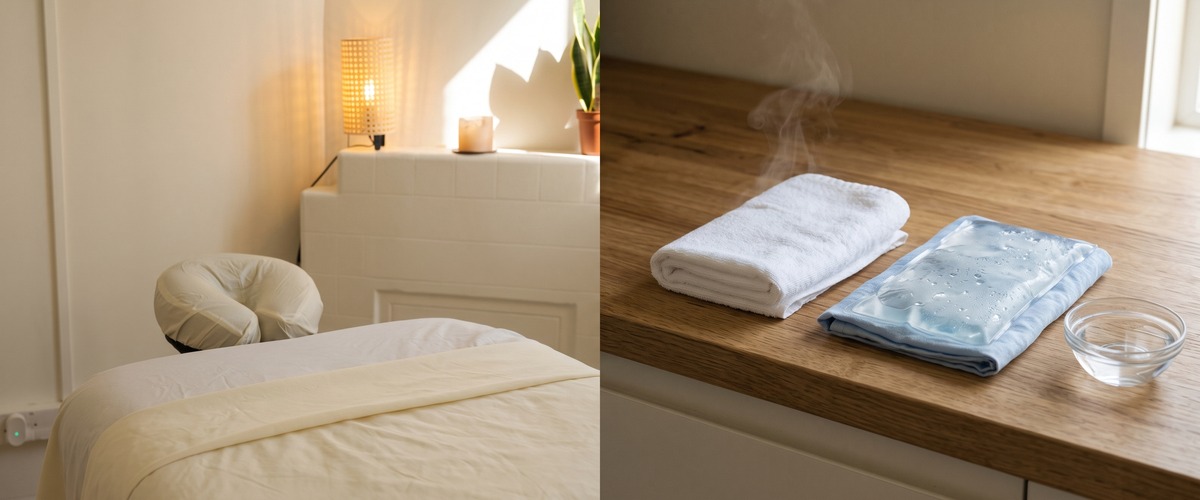
Ice is for calming fresh, swollen soreness. Heat is for loosening the old, stiff tightness. But if your sore muscles are the kind that ease off for a day or two and then creep straight back, we find alternating short bursts of both usually works better than picking one and sticking with it.
Most home advice treats heat or ice for sore muscles as a straight either/or choice, and honestly, that’s exactly why so many people never quite shake a recurring knot in the neck, shoulders or lower back. One therapy on its own calms the tissue while you’re using it, but it does nothing about the rebound inflammation that creeps back in once you stop.
Heat or ice for sore muscles: matching the treatment to the tissue
It really comes down to one question: is this fresh, swollen tissue, or old, tight tissue? Ice narrows the blood vessels and dulls the pain signals, so it’s what we’d reach for on a strain, a sprain, or anywhere that’s swollen or bruised. Heat widens the blood vessels and relaxes the muscle fibres, so it’s what works on the dull, stiff tightness that builds up over days or weeks rather than minutes.
Neither one is “better” as a rule. They’re doing opposite jobs on opposite kinds of tissue, and reaching for the wrong one can genuinely slow you down.
If home care alone isn’t shifting it, book your session today and let one of our therapists read what the tissue is actually asking for.
When ice wins: fresh strains, swelling, and Glasgow’s icy front steps
According to Houston Methodist, ice is the right call for the first 48 to 72 hours after a strain, and heat applied too early on a fresh injury can actually increase swelling rather than easing it. On dosing, the NHS advice for sprains and strains is to put an ice pack, or a bag of frozen peas, wrapped in a towel on the injury for up to 20 minutes every two to three hours. Johns Hopkins Medicine notes the same window: ice first, heat later, not the other way round.
One Glasgow-specific word of caution. Winter here means salted pavements and black ice from November through March, and if you’re already limping on a strained calf or ankle, the walk to the bin or the corner shop is where a second injury happens. Ice the strain indoors, and treat the icy pavement outside as a separate hazard altogether.
When heat wins: the tightness that keeps coming back
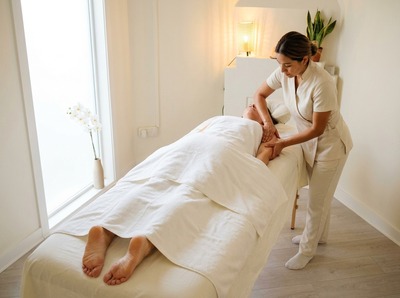
Heat is for the ache that isn’t new. Desk-bound shoulder and neck tension, a tight lower back after a round of golf, calves that ache after walking home up one of the braes in Kelvinside or Partick — all of it responds to warmth, because the muscle itself has shortened and stiffened rather than being freshly damaged.
We hear this from clients in exactly those terms. One recent review described “back and shoulder tightness” from golf that a Thai Oil Massage finally loosened, and another put it plainly: “manual labour can really strain my muscles.” That’s chronic, occupational tightness rather than an acute injury — exactly the category heat is built for.
At home, a hot water bottle or a warm flannel does the job nicely. Around Glasgow’s West End and Southside tenement flats, where central heating often isn’t zoned room by room, we’d say a hot water bottle is usually the more reliable option than waiting on a radiator to catch up.
Where heat genuinely runs out of road is tightness that returns every week regardless of how consistently you apply it. That pattern usually means the muscle has built a compensation habit that warmth alone won’t unwind, and it’s where Serendipity Massage Therapy on Hope Street can work through the pattern with deep tissue oil massage rather than just easing the surface symptom for an evening.
Contrast therapy: why alternating heat and ice beats picking a side
This is the approach most home advice skips entirely, and it’s the one worth understanding if your soreness is the recurring kind. Alternating warmth and cold on the same area — what’s usually called contrast therapy — is something physios and sports therapists have relied on for years, and it targets exactly the tightness that a single temperature never quite resolves.
It works in a simple way: heat opens up the vessels and floods the area with blood, then ice narrows them again and clears out the fluid and waste that’s built up. Cycling between the two creates a pumping action that neither temperature manages on its own, and finishing on cold keeps down the rebound swelling that a heat-only approach tends to leave behind.
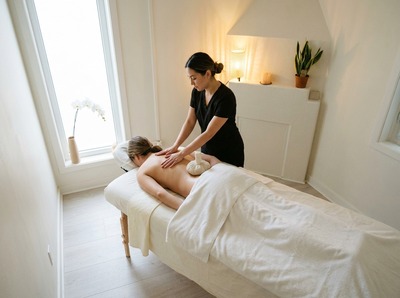
Jariya Malone, Serendipity’s head therapist, sees this pattern often. A runner once came in mid-training with calf tightness that was throwing off their gait, and rather than just working the calf directly, she addressed the fascial restrictions and the compensation patterns the body had built around it. The runner knocked a personal best off their next 10K.
Muscle tension rarely sits in isolation. That’s exactly why we’d alternate heat and ice rather than default to one — it treats the whole cycle of tightening and swelling, not just one half of it.
A practical version at home: 3 to 4 minutes of heat, then 1 minute of ice, repeated for three or four cycles, always ending on cold. Skip this in the first 48 hours after a genuine injury, when ice alone is the safer, calmer choice. If you’d rather have someone assess whether your case needs contrast work or straightforward deep tissue attention, booking your appointment online is the fastest way to get a proper read on it.
What household items actually substitute for proper hot and cold packs
You don’t need any specialist kit for this. A bag of frozen peas moulds to a shoulder or knee better than a rigid ice pack, and works just as well wrapped in a tea towel. A hot water bottle, or a damp flannel warmed briefly in the microwave, covers the heat side for most people — especially handy in older Glasgow flats where the heating takes a while to catch up with the weather.
One seasonal note: on the warm spells Glasgow does get, the same cold packs you use for sore muscles double as genuine heat relief, a good reminder that cold therapy earns its place in the house year round, not just for injuries.
The takeaway
Sore muscles aren’t a single problem with a single fix. Fresh, swollen tissue wants ice; old, stiff tightness wants heat.
If the tightness keeps coming back even when you’ve tried both, separately, on separate days, it’s usually asking for the contrast approach: short cycles of heat then cold, working with your body’s own circulation rather than against it. Home care can carry you a long way, but it can’t unpick a compensation pattern that took months to build.
If that’s where you’ve landed with a specific area, get in touch to book your appointment for Traditional Thai Massage or targeted deep tissue work, and let a trained therapist read what the pattern actually needs.
Found this useful? Add serendipitymassage.co.uk as a preferred source on Google so our latest guides show up first for you in Search and AI Overviews.